
About SwayJoy
High school computer teacher Holy Yang and his SwayJoy
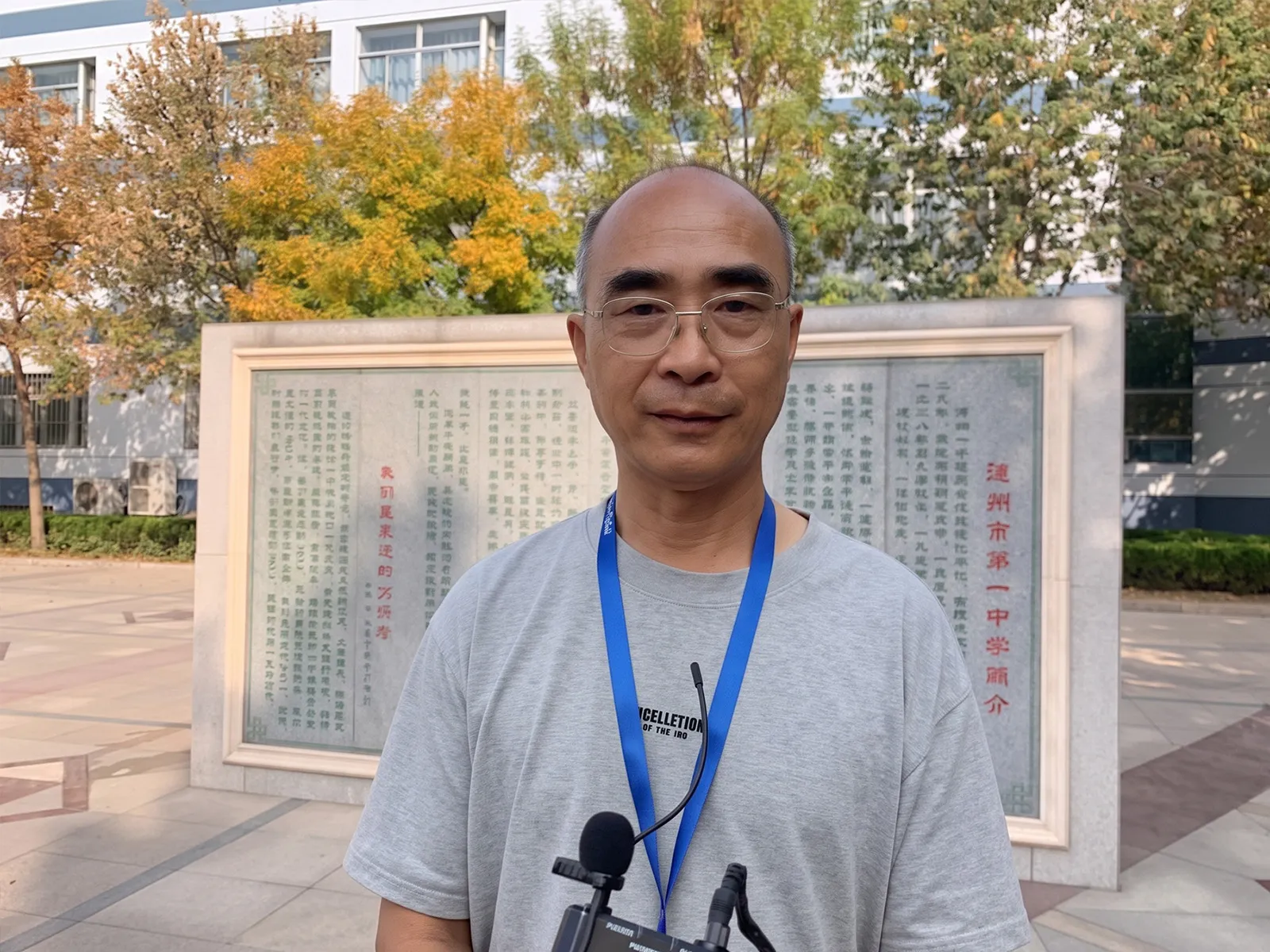
The Old Fan in the Computer Room
Spring 2025. An ordinary high school in a small southern town. The old fans in the computer room hummed. Fifty-two-year-old Teacher Yang sat at the machine in the last row, the blue glow of the screen on his tired eyes.
The students called him Holy Yang behind his back. He had picked the English name for himself more than twenty years earlier, back when it had sounded solemn. They said it with a grin now, and he didn't mind. A man who had taught computers for nearly thirty years had long since learned to be knocked over by the tide of the times and to get back up again.
His career almost traced the whole history of computer education in China. He taught BASIC. He taught Pascal. He showed students how to format a floppy disk in DOS. Then the reforms came, and year after year he taught Office, taught typing, drilled the questions on the exam prep list. One thing had gnawed at him the whole time: the textbooks taught students to use a computer, never to build something. Mathematical thinking, logical structure, taking a vague idea and breaking it into steps a machine can follow. None of that ever really grew in the cracks between exam questions.
JavaScript at Midnight
At the end of 2024, Yang went to a small tech meetup and watched someone use Google's open-source MediaPipe for hand tracking. Open a web page. Wave your hand at the camera. Twenty-one hand landmarks light up on the screen in real time, and a swipe of a fingertip slices a virtual fruit. No installer. No dev environment. Just a URL.
He sat still for a moment. This was the bridge he had spent thirty years looking for. On one side, the math he most wanted to teach. On the other, the games kids most wanted to play. Between them, one web page.
Over the winter break he worked through MediaPipe's browser documentation page by page. Learning something new at fifty-two is not a dignified business. JavaScript callbacks tied him in knots. getUserMedia refused the camera permission and threw errors. At two in the morning he would stare at a canvas that refused to draw its landmarks and wonder if he was too old for this. He had one stubborn method: he copied every line of code that worked into a thick notebook, the way he had copied BASIC programs decades earlier. By the end of the break the notebook was more than sixty pages long, and his first motion game worked. He called it Air Piano. Hold up your hand, drop your palm, and it strikes a key on the canvas from across the room.
First lesson of the term, he projected the page for a second-year class. The room went quiet, then it exploded, because every student could open the same page right then on their own phone.
Math Finally Got a Temperature
Yang's classes quickly got a reputation. His method was stubborn: before writing a single line of code, draw a picture.
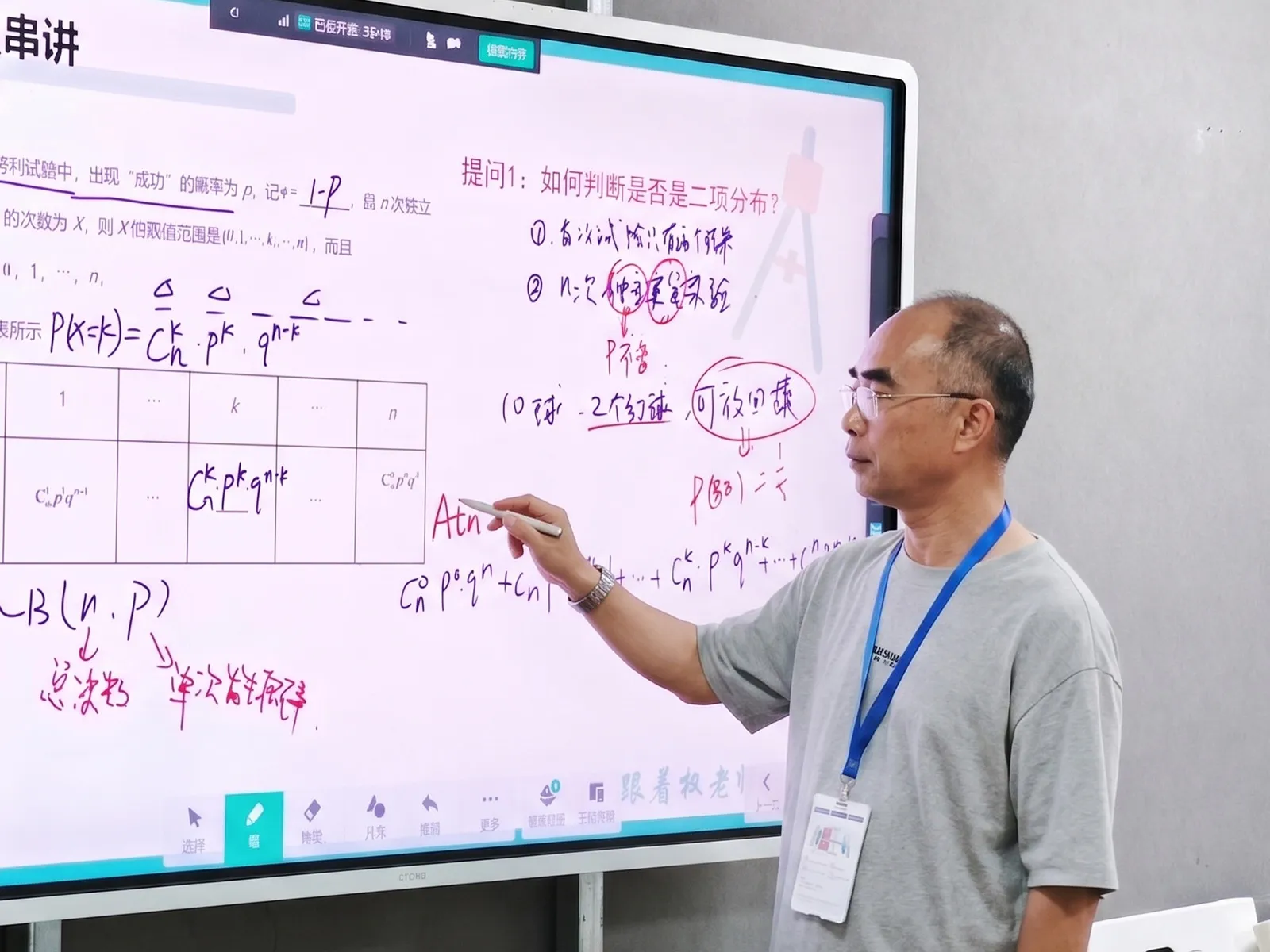
Teaching MediaPipe hand tracking, he didn't rush to the API. First he drew a coordinate system on the blackboard. The top-left corner of the canvas is the origin. x runs right, y runs down, and every coordinate is a normalized decimal from 0 to 1. "The Cartesian plane you learned in middle school," he said, "is now controlling a real hand."
Teaching gesture detection, he talked about vector angles. How do you work out the direction of a finger from two 3D points, the fingertip and the wrist? Dot product. Magnitude. Inverse cosine. Trigonometry stopped being a dead problem on a test paper and became a live judgment call in a game: did this punch land or not? One boy who had failed math for years re-derived the law of cosines on his own so his boxing game would judge hits more fairly. Later, at a teaching meeting, Yang said, "That day I stopped believing the kids can't learn math. We just never gave math a temperature."
Around the same time, he put Claude in front of the students. From then on, nobody typed out fifty lines of boilerplate by hand. A student described what the game should do in a few plain sentences, Claude wrote the code, and the student spent the energy on the part that actually mattered: the flow, the order of the steps, the edge cases, the rules of the program. Kids who had choked on syntax were suddenly designing the structure of a real game. One of them told him it felt like programming had stopped being about typing and started being about thinking.
By the end of the term the projects were all over the map. Someone made a motion version of Fruit Ninja, slicing melons with a wave. Someone made a posture corrector that watched the pose landmarks and popped a warning when you slumped too far; its first user was the kid who built it. Someone made an Air Guzheng out of the distance between two hands and played a few bars of an old wuxia tune.
SwayJoy: Turning Sway into Joy
Then came the problem: the projects were done, they went into a folder, they were handed in, and then what? The games sat on a hard drive. No players. No applause. The kids' excitement was a firework that never got lit.
In the second half of 2025, Yang decided to build a platform. He knew nothing about products and nothing about running a business. A computer-room teacher commands roughly zero resources. But this time he had the advantage, because the students' games were already web pages. SwayJoy only had to put those pages online.
He threw together a plain site with a static site generator and rented a cheap cloud server. Each game got its own page: how to play, how to download, the developer's name and photo. Click, and it ran. He built most of it the way he now taught: he described what he wanted, Claude wrote the code, and he fixed what wasn't right. It felt, he told a friend, like having a tireless assistant who never slept, which left him free to spend his energy on the part he was actually good at: deciding what the thing should do.
The platform needed a name. He went through a lot of words and landed on SwayJoy. Sway, plus joy. "Motion gaming is, at its heart, the happiness of moving your body," he wrote on the homepage:
"Here, every game belongs to a high school student. Their hands sway in front of the camera, and their names should shine on the work."
Among the first dozen games, the most popular was a little ball-dodging game by a girl so quiet she was almost invisible in class. On her game's page, under her photo, she had written: "I used to think I was only good at exams. Turns out I can make something that makes people laugh out loud." Students across the school shared that line hundreds of times.
A Teacher's Final Move
People asked Yang why he bothered, with retirement only a few years away. His answer was plain. "My generation has been through every turn of computer education, but most of the time we were just turning. We never really ran. Now web development and open tools like MediaPipe have dropped the bar low enough that a high school student can reach it. No environment to install, no equipment to buy, just a browser. I don't want to stand on the sidelines now that the bar is finally low."
SwayJoy is still small. The server stalls sometimes. The pages are nothing to look at. But it grows every month: new student projects, new gesture mechanics, and letters from teachers at other schools asking how to run the same class. Yang answers every one of them, then gets back to preparing lessons.
The old fan still hums in the computer room. In front of the camera, another group of kids lifts their arms, and twenty-one landmarks light up between their fingers, like a small breathing star chart. Fifty-two-year-old Holy Yang stands at the back of the room and says nothing.